
From conversation
to improvement
Why we started Tovara
An employee searches for an answer a colleague once found. In a handover, the reason behind an agreement disappears. The system stores all the data, but one experienced colleague keeps having to explain what needs to be done with it.
I saw this for almost four years as a Business Central consultant at trading companies. Besides the software, I always looked at the work around it: who needs which information, and where does a handover go wrong? That is what Tovara is for.
This catalogue shows how we work, with two examples from our own work: BMS (Business Model Software) and the Ticket Agent. Then come five ideas, each with a number. The number that appeals most is where the first conversation begins.
Jonathan van de LustgraafFounder

We start with how the work is done today
AI is a means, not a goal. Together with the people who do the work, we capture the process in a map that everyone can read and correct. Only when the map is right do we choose for each step: simplify, make better use of existing software, automate, AI, or keep as is.
- 01The conversation
The team explains how the work is done. BMS maps it and we ask further questions when a step is missing.
- 02Correcting together
Together we read the map back and point out what happens differently. The agreed version is the basis for everything else.
- 03Choosing what fits
For each step, we determine what changing it would deliver. Sometimes that is a better agreement, sometimes automation, sometimes AI.
The work mapped and clear where it can improve
In conversations with the people who do the work, we map a process. The analysis and a substantiated direction for improvement can be the whole assignment.
The maps of the work examined remain available. We agree in advance on how an improvement will be assessed.
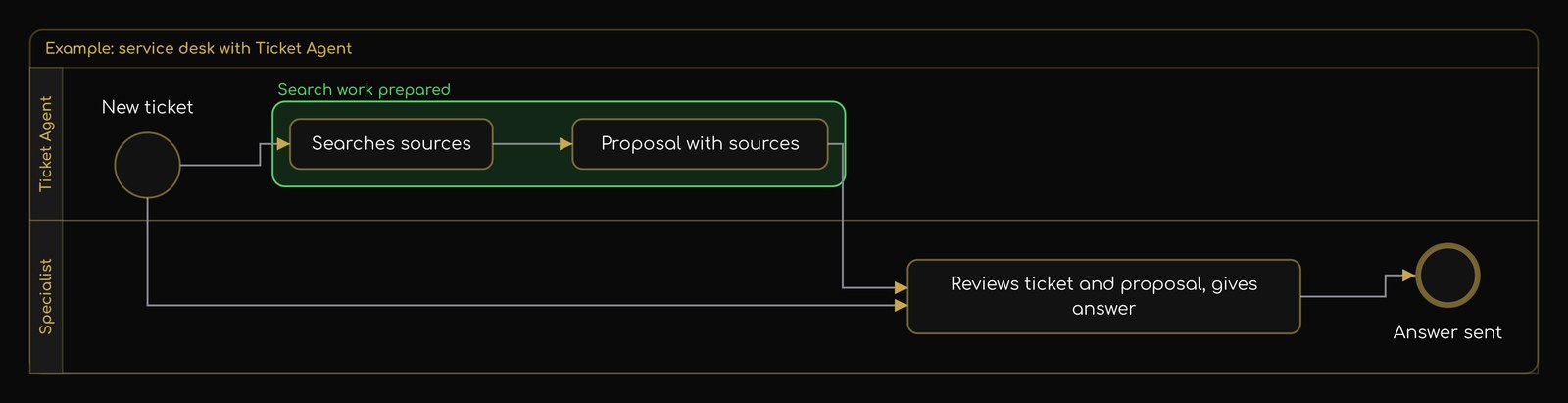
- The process map
- Who does what, in which order, and where the work passes from one person to the next.
- The story per step
- A short explanation at each step, so that even people who were not there understand it.
- Bottlenecks and opportunities
- Where work stalls or keeps being figured out again is marked.
- Advice per step
- Keep it as it is, automate, use AI or let a person decide. With the reason included.
- A direction for improvement
- A different agreement, better use of existing software or a new application.
A map everyone can read and correct
BMS is our own software for mapping work processes. It connects the map with text: how a process runs, who is involved in a step and what a handover means.
Example. In a conversation about order processing, we put the steps from order to delivery on a map. An employee sees that the stock check is missing and explains when it happens. The map is adjusted, so that everyone can read back the same way of working.
- Creating and editing maps
- An explanation at every step
- Documents across multiple pages
- Sharing and comments
- Viewing earlier versions
- Exporting
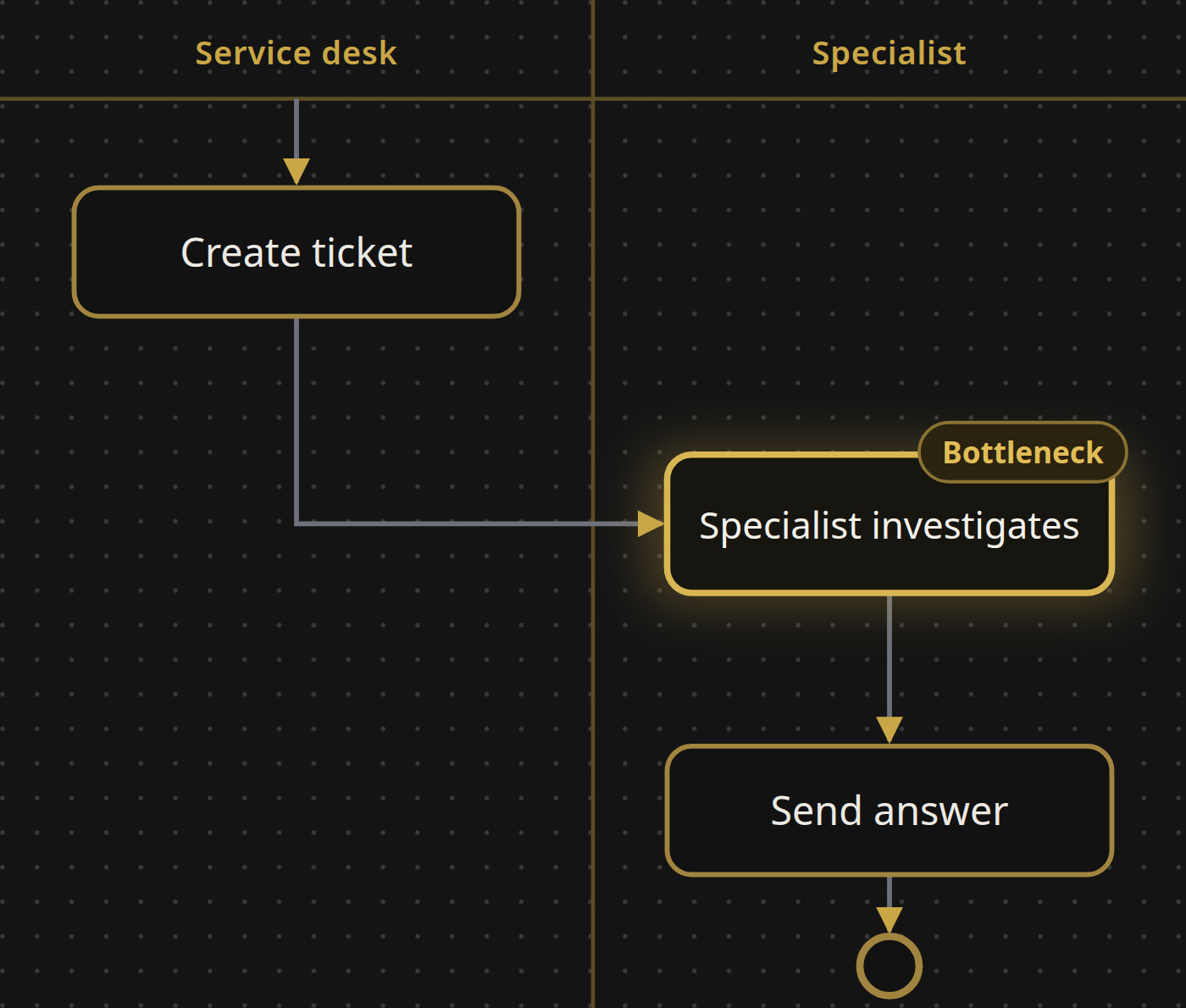
The knowledge is there. But who knows where?
A specialist who picks up a ticket starts by searching: in previous reports, in the documentation, in the knowledge base. Often a colleague has already solved exactly this problem. That answer sits in a closed ticket, but it is hard to find again.
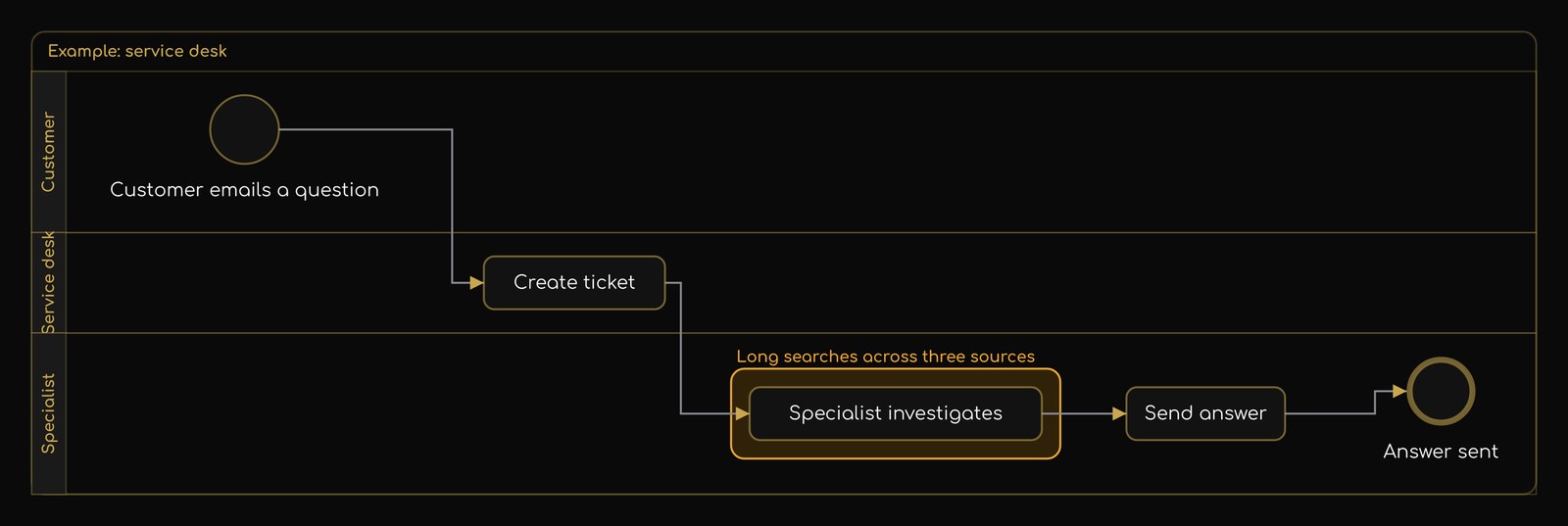
The groundwork is ready
The people stay. The groundwork is ready for them.
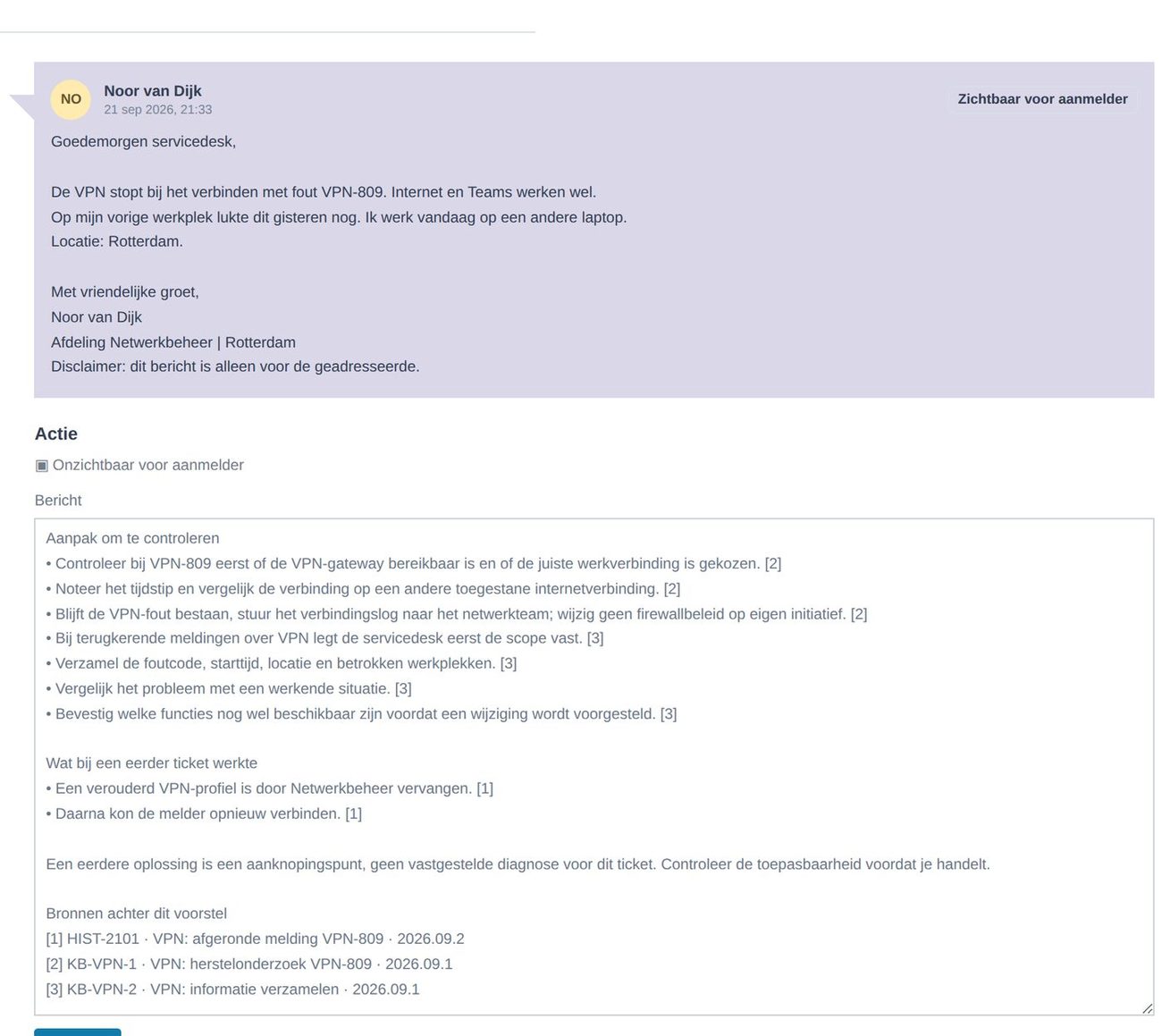
For a new ticket, the Ticket Agent searches the same sources as the specialist. It puts a proposal in the ticket as an internal note, with the sources included. The customer does not see it.
The specialist reads the proposal, checks what is needed and writes the answer themselves. If the Ticket Agent finds nothing useful, the note says so, along with the information that is still needed.
- Works alongside the ticket system already in use. We build the connection on request.
- First a trial on previously closed tickets, compared with what the team did at the time.
- Runs on Microsoft Azure in European data centres. The tickets are not used to train AI models.
- Set-up in about seven working days.
The Ticket Agent does the groundwork. The specialist decides how the customer is helped.
Where is it for you?
The kind of work says more than the sector. Where do colleagues keep searching for the same information? Where is knowledge lost in a handover? Which task needs explaining again and again? Five situations, each with a number.
- 01Service desk
- 02Orders and delivery
- 03Service and repair
- 04Handover and onboarding
- 05Working with AI

The answer is in a closed ticket. But which one?
- Now
- A specialist first searches previous reports, the documentation and the knowledge base before they can help the customer.
- Possible
- For a new ticket, the Ticket Agent prepares the groundwork: a proposal with the sources included. The specialist decides.
What is includedTicket Agent, starting with a trial on your own closed tickets

A step everyone does, but that is written down nowhere
- Now
- The stock check does happen, but only the colleague who always does it knows when and how.
- Possible
- The steps from order to delivery on a map, corrected by the team. After that, everyone can read back the same way of working.
What is includedProcess analysis with BMS

The repair is quick, the customer waits long
- Now
- The work stalls somewhere in between: in the handover, the planning or the information.
- Possible
- See on the map where the work stalls, and choose the first improvement there.
What is includedProcess analysis

One colleague who has to explain everything
- Now
- The system stores all the data, but one experienced colleague keeps explaining what needs to be done with it.
- Possible
- That explanation is added to the steps on the map, so that a new colleague can read it back.
What is includedProcess analysis with BMS

Getting started with AI. But where does it help?
- Now
- There is a wish to work with AI, but no clear picture yet of where it pays off.
- Possible
- For each step of the work, we look together at where AI makes sense and where it does not. Sometimes a better agreement or the existing software is the answer.
What is includedProcess analysis
From introduction to delivery
- 01Introduction
We hear the question and see whether Tovara can offer a suitable next step. After that, what the next step delivers and what it costs is fixed.
- 02Process analysis
Together with the people who do the work, we map the process and choose a substantiated direction for improvement.
- 03Design
Before building, we record the desired behaviour and boundaries, with concrete examples against which the delivery is assessed.
- 04Building and delivery
The responsible manager and the users assess the result together with us. The delivery includes a manual.
Not every project goes through all the steps. The process analysis can be the whole assignment.
What we promise can be checked
 JonathanFounder
Examines how the work is done at a client and which improvement helps. Worked for almost four years at a Business Central partner for trading companies, with many warehouse processes, and for a year at a Zoho partner with clients from all kinds of sectors.
 TheoBack and front office
Point of contact for appointments, planning and administration.
- Transparency
- Nobody has to trust an outcome blindly. A proposal always comes with its sources.
- Measurability
- We agree in advance on how an improvement will be assessed.
- Quality
- The smallest solution that works reliably and can be maintained. Where it matters, a person keeps the final check.
Get in touch
Seen an idea that fits? Mention the number in a reply to the email, or call Jonathan. In the web version, the saved ideas come to us with one button.
Which ideas fit you?
Save an idea with the button on the page. With your name and email address, the saved ideas reach us, and the first conversation starts there.
No ideas saved yet.